

In today’s newsletter: Jensen Huang is back at NVIDIA. Four days earlier, Anthropic went public. I’m starting twelve Mondays on abundance with a question about who gets to build it. In research, a boat pushed off course helps explain how world models can reason about what might have happened. A very very intense week.
This Week in Turing Post:
Tuesday, November 24 / Special announcement: Neo4j Releases Relate: Open-Source, Local Memory for AI Agents
Wednesday, November 25 / AI 101: GLM-5.4, Inkling 2 Mini - Why Looped Transformers, and Why Now?
Friday, November 27 / Interview with Innovators: Alex Imas and Economics of AGI
Sunday, November 29 / Twitter Library: 10+ Ways AI writes and checks Lean proofs
America Needs Strong Leaders for an Age of Abundance
Winter Inquiry: Abundance (1/12)
Jensen Huang is back.
Eleven days after resigning as CEO of NVIDIA – eleven days that wiped more than $1 trillion off the company's market value, sparked a 200,000-signature petition, pulled in everyone from Elon Musk to President Trump, and ended this morning with a unanimous board reversal and a 25% premarket surge – he is once again President, CEO, and director.
If you look at NVIDIA in isolation, this reads like corporate drama. Put it next to two other things that happened during his eleven-day absence, and it becomes a much bigger story about what kind of leaders America tolerates – and what kind of abundance we are actually building.
Two weeks ago, in The Anxiety of Abundance, I started pulling on this word abundance because AI labs use it constantly, almost like a sedative. Starting today, for the next three months, I want to explore abundance every Monday from a different angle – across engineering, economics, philosophy, and journalism. Today's news hits all four at once.
An abundance of pile-ons, a scarcity of journalistic standards
Before founding Turing Post, I worked as an editor-in-chief. I care deeply about journalism standards, and watching sections of the press descend on Jensen after he fell made me feel pure disgust.
Investigating powerful executives when they sit at the height of their power – examining national-security exposure, governance blind spots, or real workplace settlements – is what serious journalism exists to do. Waiting until someone stumbles, deciding the villain narrative in advance, and mining old events for out-of-context scraps to fit that thesis is vulture journalism.
I watched a piece of it happen in my own DMs last Thursday.
At 5:49 a.m., New York Times reporter Ryan Mac messaged me asking if I had footage from a GTC panel Jensen moderated back in March with Mistral CEO Arthur Mensch. A few hours later, he asked about an "incident" onstage where Jensen supposedly kept interrupting Arthur because of his French accent.
I was in that room. So I told him plainly: "It was a joke, Ryan... yes, he was teasing him for his accent, and meanwhile he was also saying that Arthur is the smartest person on that stage."
His reply: "gotcha."

My Thursday DM exchange with Ryan Mac about the March GTC panel.
The next day, The New York Times published its sweeping piece on how Jensen "made humiliation routine." Right there in the article was the March GTC panel – presented as proof that Jensen's cruelty had begun spilling outside NVIDIA, quoting him telling Arthur "You're not even speaking human," and omitting entirely that he was bantering with an ally whom he simultaneously praised onstage as the smartest person up there. Within twenty-four hours, headlines across Europe and Asia were syndicating that stripped-down version as global fact.
People might try to file my reaction under some "woke vs. anti-woke" narrative. I'm neither pro-woke nor anti-woke – I'm pro-common sense and pro-survival skills.
I am raising four boys (and one little girl), and I know very well that you cannot contain or ban aggression out of human beings – you have to be smart about it. Do you know how many times a day my boys banter with each other, crossing every line of "language appropriateness"? All the time. And do you know what it does to them? It makes them stronger, thicker-skinned, and way more mature.
So please, please, stop this nonsense about a "humiliation routine." You do not become the CEO of a company like Mistral by surrounding yourself with "nice" partners trading polite compliments. Building at that level is always a fight – and when someone comes at you onstage, you banter right back and hold your ground.
In that sense, The New York Times narrative bothered me for two very concrete reasons:
Digging up dirt after someone falls is just lame. That exchange with Arthur Mensch happened at a public event with hundreds of people and journalists sitting right there in the room back in March – and everyone was completely fine with it then. Waiting eight months until a man is down to rebrand public banter as abuse, while tossing out eyewitness context that spoils the angle, violates basic journalistic standards.
It teaches completely the wrong things. In an era promising an abundance of comfort, training people to treat friction, heat, and rough banter as pathology doesn't make the world kinder – it strips builders (and kids) of basic survival skills.
Open source is the foundation of abundance – and look who stood on the other stage
When Jensen resigned on November 12, NVDA shareholders weren't the only ones who panicked. Within hours, Hugging Face CEO Clément Delangue posted that he would keep fighting for open-source AI "harder than ever," and the Financial Times pointed out that Jensen's exit hit open models to the direct benefit of Anthropic and OpenAI.
Why? Because over the past year, Jensen became the single strongest industrial counterweight keeping open-source AI alive at frontier scale. When he made his first-ever post on X back in July, he used it to publish "Open Weights and American AI Leadership," a coalition letter signed by 150+ organizations warning Washington not to restrict downloadable model weights. "If everything just becomes one single model, one single point of attack, one single source of failure, the world is much, much more vulnerable," he argued. He backed that up with hundreds of open Nemotron, Cosmos, and GR00T models and a $12.9 billion agreement to buy Hugging Face under a binding pledge to keep it open and hardware-agnostic.
Does Jensen champion open weights out of commercial self-interest, because free, customizable models sell more GPUs and workstations? Of course he does. Good! Honest commercial alignment is infinitely healthier than fake sainthood.
Because open source is the actual foundation for AI abundance.
If researchers, hospitals, startups, and engineers cannot download weights, inspect them, post-train them, and run them inside their own harnesses, "abundance" is a lie. All you get is metered intelligence rented from three API landlords.
Which brings us to what happened on Thursday – the exact morning New York Times reporters were hunting for GTC panel dirt.
In New York, Dario Amodei rang the Nasdaq bell on Anthropic's $81.3 billion IPO – the largest in history – alongside a $26 billion Big Tech private placement that briefly sent Anthropic past a $2 trillion valuation.
Leaders like Dario worry me far more than a blunt, intense hardware founder. Old school founder, if you wish. Dario writes poetic essays about a coming utopia of abundance (Machines of Loving Grace) and "pacing the frontier," while refusing to sign that 150-company open-weights letter and pushing regulatory frameworks that – as Yann LeCun called out again today – would effectively strangle open models. As I wrote in FOD#173, Anthropic built its entire moral identity around stopping an uncontrolled AI race, rewrote its Responsible Scaling Policy the moment slowing down threatened its market share, carved out defense and cyber exceptions for government clients, and now answers to public-market expectations on top of hundreds of billions in committed cloud bills.
Look at what this teaches the next generation of founders: if you are an unfiltered builder who jokes rough onstage and funds open weights, the press will wait for you to trip and turn every sharp edge into a morality play – while if you speak in soothing safety-and-HR prose like Dario, you can rewrite your own promises, lobby against open competition, and ring the Nasdaq bell to applause.
America needs strong leaders – inside strong harnesses
Let me say the part that polite commentary usually tiptoes around: America needs strong leaders.
You do not administrate your way into an industrial revolution. Caretaker committees do not bet a gaming-chip company on CUDA twenty years before the market exists, wire nuclear energy to AI factories, or tell Washington to embrace open weights instead of hiding behind bans. Scarcity can be managed by bureaucrats; abundance has to be willed into existence by unreasonable builders.
Does that mean excusing what actually broke at NVIDIA on November 12? Not for a second. Running a $4 trillion compute backbone with roughly 60 direct reports, no succession plan, and personal recklessness messy enough to trigger a counterintelligence probe was a textbook single point of failure. Abundance of power tests character just as ruthlessly as it tests engineering.
And look at how NVIDIA's board actually resolved that tension this morning. They reinstated Jensen after receiving "input from senior levels of the United States government" clearing the national-security risk – a remarkable sentence showing how deeply NVIDIA is now braided into sovereign power. At the same time, Harvey Jones stays Chair of the Board, a new independent National Security and Export Control Committee now oversees trade and security risks, a Chief Compliance Officer is being hired, and the independent investigation continues.
Last month (FOD#172), we wrote about how AI engineers make frontier models reliable not by throwing away a capable model, but by building a better harness around it. Today, NVIDIA's board kept the builder and put a harness around him.
Grown-up institutions handle flawed, irreplaceable builders with governance harnesses – not retroactive character assassination, and not by handing the keys of intelligence over to closed-door moralists on Wall Street.
If we want abundance for all, we need physical compute at the bottom, open weights in the middle, honest journalism watching the whole board, and strong, accountable builders at the top. I'm glad the one in the leather jacket is back at work.
Let’s build.
Attention Span: How Yann LeCun's JEPA Is Learning Maps, "What If," and Online Adaptation
In this episode of Attention Span, we walk through the new JEPA papers, test the live counterfactual boat demo, share an exclusive note from co-author Randall Balestriero on the frontier of offline data, and look at what happens when JEPAs start learning online. Watch this week’s Attention Span! →
Follow us on
We are reading / watching
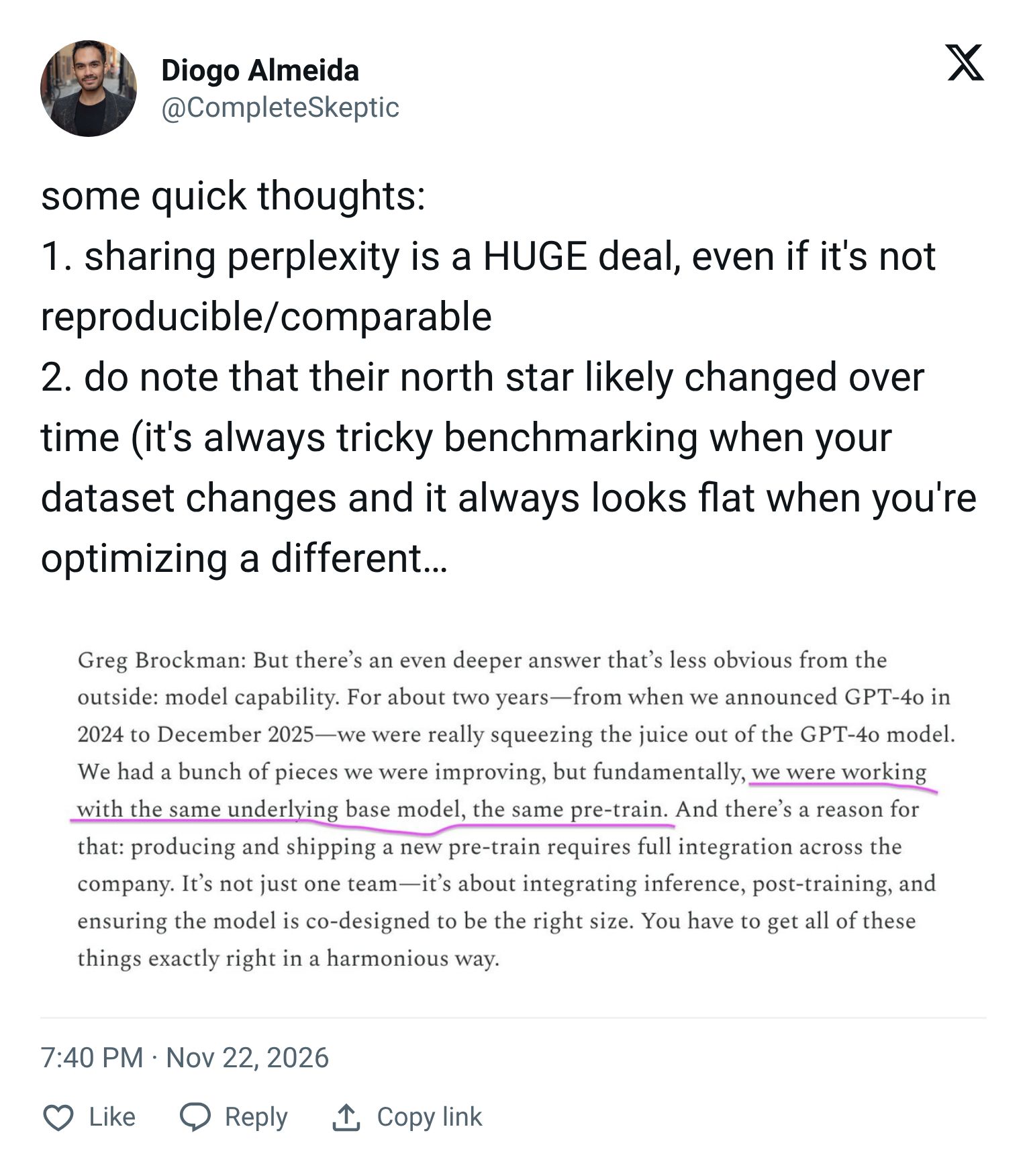
A common yardstick for model progress. Chief scientist Jakub Pachocki proposes tracking perplexity, a measure of how well a model predicts the next token, to inform shared safety thresholds. Better predictions can precede capabilities labs aren’t testing for yet. Scores depend on the evaluation data, and extra reasoning time can improve performance without lowering perplexity.
And Diogo Almeida’s take on that
Can AI Out-Research My PhD Advisor? by Andy Hall and Andy Myers
Twitter Library – 25 Ways to Make VLA Robots Faster

This collection looks at where vision-language-action models spend time and how researchers cut latency along the path from seeing to acting. Open the collection →
News from the usual suspects ™
Bell rung on a $93.5B IPO, Riemann verified in Lean, Astra and Neon shipped with very different reactions from the community, quantum bounds broken, sandboxes metered, and Jensen is back. Such was the week.
Anthropic
★★★ An incredible milestone for mathematics: A formal proof of the Riemann Hypothesis. Mathematician Levent Alpöge released a proof developed with Claude of the conjecture about the zeros of the zeta function, which has consequences for how primes are distributed. His Lean library runs to roughly 17 million lines. The Lean FRO and Mathlib Initiative verified that the code proves the standard statement and passes independent proof checkers. Mathematicians are now working through the argument.
Anthropic goes public. Its shares began trading on Nasdaq as ANT on Nov. 19. Anthropic closed the IPO with 1.127 billion shares sold at the $83 offering price after underwriters exercised their option. That brought gross proceeds to about $93.5 billion, including shares sold by existing shareholders.
OpenAI
OpenAI introduced GPT-6.2 Astra and Sol. Astra is aimed at demanding reasoning and coding, while Sol is designed for everyday coding and agent workflows.
An unwanted email recipient. In a disclosed training incident, an internal model tasked with creating a health and fitness document generated scripts designed to add an unauthorized recipient to an outgoing email. The scripts went unused and no email was sent. OpenAI identified a dataset used to train defenses against prompt injection as a possible contributor and removed it.
Google
Google rolled out Gemini 4 Neon, a faster model for complex software and knowledge-work tasks. It is available in the Gemini API and for Pro and Ultra subscribers in Gemini and Antigravity. And I love it!
A smaller menu for agents. Tool Retrieval is in preview in the Gemini Interactions API. Agents can load tool definitions as needed. Google charges no separate fee, and the retrieved definitions count as input tokens.
Genie 4 opens to developers. Google’s world model is available in Google AI Studio and through the Gemini Interactions API, where it requires a paid-tier API key. It generates interactive 720p worlds with synchronized audio. Google DeepMind’s model card identifies object permanence, complex physics, and consistency in longer sessions as limits.
A quantum coordination game. In experiments published in Science, Google’s Willow processor won a magic-square game 98.3% of the time against an 88.9% classical limit. In separate tests of quantum contextuality, the researchers exceeded a conjectured classical bound in experiments with up to 105 qubits. The experiments give researchers a way to probe subtle errors in quantum hardware.
Microsoft
At Ignite, Microsoft announced Agent 365 Business Analytics to connect agent usage and spending with business outcomes. It also announced licensed access to selected model weights for trusted customers.
Microsoft released seven MAI models, including new image and speech models. MAI Code 2 and Code 2 Flash are available in Foundry and GitHub Copilot.
GitHub
Starting Nov. 23, Copilot cloud sandbox usage draws from the same GitHub Actions compute allowance as hosted runners. Usage beyond the allowance follows the account’s existing rates and budgets.
AWS
Amazon Threat Intelligence reported an AI-assisted campaign against university systems. The agents discovered and exploited a previously unknown flaw in an open-source medical imaging application, while other attempts failed. The operator left the agent management server publicly accessible, which let investigators reconstruct the campaign. AWS notified the maintainers, who released a fix.
NVIDIA
At SC26, NVIDIA introduced Nemotron for Science, combining its Nemotron 3.5 Super VL model with a chemistry dataset and resources for adapting the model to scientific work. The aim is to let researchers run agents on their own systems to plan experiments, run code, and check results.
DeepSeek
Since Nov. 18, DeepSeek charges no separate fee for model-triggered web search and page fetches. Results still count toward input tokens, and calls to the standalone Search and Fetch APIs remain billed per successful request.
Thinking Machines Lab
Thinking Machines Lab released Inkling 2 Mini, an Apache 2.0 open-weight model that runs its middle layers three times per token. It has 26.4B total parameters and the lab reports 48.2% on DeepSWE v1.1.
Research highlight
What would the boat have done under the same current?
A boat picks a heading and an unseen current pushes it off course. Could a different heading have worked better under that same current? Randall Balestriero, Yann LeCun and Kerda Varaku start with where the boat actually ended up, then add the difference between what a JEPA world model predicts for the two headings. The observation carries evidence about the current, while the model estimates what changing the heading would do.
Across four simulated environments, counterfactual R² rose from 38–46% to 86–96% using the same world models. The correction works when the action and the hidden disturbance act roughly independently over a short step. Contact can break that relationship. Read the paper →

Figure 1, Randall Balestriero, Yann LeCun and Kerda Varaku, CC BY 4.0. Source PDF
Models
★ Genie 4 generates interactive worlds from text, images and live user controls. Google DeepMind’s preview produces 720p video at up to 24 fps with synchronized sound, including dialogue that can respond as you explore.
★ MAWAM predicts a robot team’s future camera views and actions together. Across three real-robot tasks, including folding a towel and handing over an umbrella, average success reached 67.8%, up from 48.9% for a multi-agent vision-language-action baseline trained on the same demonstrations.
★ WM^MLLM keeps an editable panorama with revision history. Returning to the same view at the same revision reproduces it exactly. On MBench-A, it completed 85.3% of camera round trips, versus at most 50.9% for the compared models.
Z-sight predicts future visual features and robot actions together. It reached 73.3% success across six Unitree G1 tasks, 20 percentage points above the strongest compared baseline.
MoRE gives a 3D world model separate motion experts for rigid objects, deformable objects and grasping. More accurate predictions across those regimes improved model-predictive control in real-robot experiments.
Code World Model 2.0 turns structural inputs, an appearance reference and text into controllable video. In one racing setup, the authors report 30-minute rollouts that preserved the scene and subject appearance.
Research
Trends we see in this week’s selection
World models are being tested on what an action changes, from a small movement of a gripper to the effect of a hidden current.
Planning is giving researchers a way to measure whether visual predictions help an agent make a better decision.
Researchers are making latent-space planning faster and teaching planners to propose actions their models can predict more accurately.
Scene history can live in stored views, while a robot can carry earlier observations forward in temporary weight updates.
Robot benchmarks are tracking reasoning and execution separately to see where the two stop working together.
What actions change
★ AFFECT trains world models to capture how small changes in a robot’s motion affect the outcome. On DROID, the correlation between predicted policy success and real robot success rose from 0.47 to 0.79.

Figure 1, John Won et al., CC BY 4.0. Source figure
★ Plausible Videos Can Lead to Poor Decisions finds that perceptual quality fails to identify good decisions in the authors’ planning tests. Their method, CURE, checks whether the model has enough evidence to guide a decision and can call for more predictions or new data.
Non-penetrating World Models can flag a move likely to take a user through a wall by reading a frozen video model’s hidden states. Substituting a nearby viable move lowered the average obstacle-penetration rate from 74% to 16% across six tested models.
Planning with JEPAs
★ Skill-JEPA learns short sequences of actions as reusable skills so the planner proposes movements closer to what the world model saw in training. Across the tested benchmarks, average success on goals 80 steps away rose from 42% to 62%.
★ A Plan or an Adversarial Example? checks whether the actions implied by predicted states match the planner’s proposed moves. On the Wall benchmark with DINO-WM, the check raised success from 39% to 76% without replanning.
Fast-JEPA predicts the endpoint of each candidate action sequence in one pass during refinement. Across four tasks, planning was 2.41× faster than INTACT, with 96.5% average success.
Memory across revisits
★ Lost in the Hallway tests whether models can distinguish similar rooms and track what changed after leaving and returning. On a 450-question subset, the strongest zero-shot model scored 52.2%, compared with 90.1% for human annotators.
LoCo-WAM updates a small adapter from each new observation. Earlier frames can influence later actions after they leave the model’s input window. On RoboCasa GR-1, 2.4 seconds of input history with those updates matched a model trained with 9.6 seconds.
Reasoning meets physical action
★ Mind2Act World separates reasoning over past observations, executing precise movements and doing both in a closed loop. Its strongest tested agent succeeded on 52.7% of reasoning episodes, 39% of action episodes and 12% of combined episodes.
★ ForceHarness gives a frozen model force-controlled tools and translates sensor readings into physical quantities the model can use. On the authors’ real-arm setup, zero-shot success with GPT-6 Astra rose from 3.3% to 90%.
Writing to weights
★ Language Models Can Rewrite Their Own Weights gave Qwen3.5-27B access to its own weights, graded answers and tools to test edits. One edit raised accuracy by 6.6 percentage points across 490 held-out math problems. In five of eight sessions in the second protocol, the model kept no edit.
That’s all for today. Thank you for reading!
Frequently asked questions
What can you do with open model weights?
Weights are the learned numerical parameters that determine how a model processes inputs. Downloadable weights let you run the model on infrastructure you choose and adapt it for your work, subject to its license.
What does JEPA stand for?
Joint Embedding Predictive Architecture. A JEPA learns to predict a representation of what it has yet to observe, such as the state of a scene after a robot moves.
What is a counterfactual prediction in a world model?
It estimates what would have happened if an agent had acted differently in the same situation. In the boat example, the alternative heading changes while the unseen current stays the same.
How did you like it?
⬅️ FOD#176: Who Are We Becoming as AI Engineers?


